Stevie Ray Vaughan's Final Concert Ticket: Alpine Valley, 1990
At first glance, this is an Eric Clapton lawn ticket. Read the venue and date together, however, and it becomes a document from one of the most consequential nights in modern blues history: Alpine Valley Music Theatre on August 26, 1990, when Stevie Ray Vaughan played his final concert.
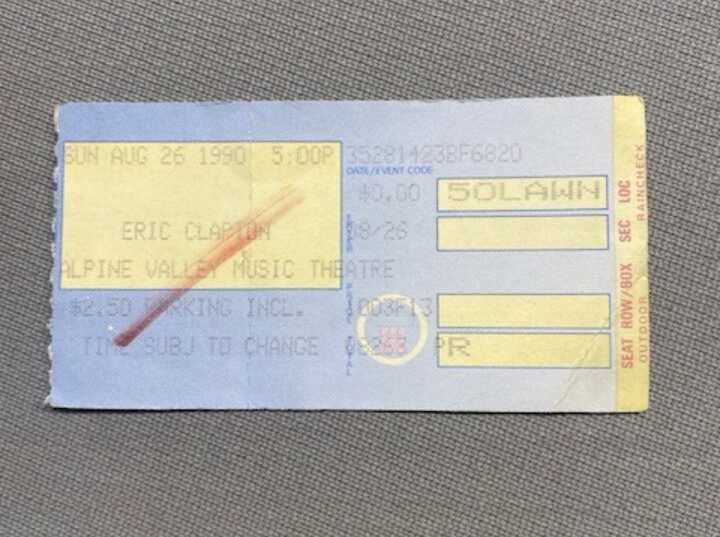
Research note: This article separates details visible on the ticket from facts established by published concert and news records. The photograph documents this particular ticket, but a photograph alone is not third-party authentication.
Artifact at a glance
| Printed headliner | Eric Clapton |
|---|---|
| Date | Sunday, August 26, 1990 |
| Time | 5:00 p.m. |
| Venue | Alpine Valley Music Theatre, East Troy, Wisconsin |
| Admission | Lawn |
| Printed price | $30 |
| Historical connection | Stevie Ray Vaughan's final concert set and final onstage performance |
| Image credit | Bob Hults, used with permission |
| Last reviewed | July 30, 2026 |
What can be read directly from the ticket
The ticket itself supplies five core identifiers: Eric Clapton, Alpine Valley Music Theatre, Sunday August 26, 1990, a 5:00 p.m. time and lawn admission. The printed price is $30. Those details can be evaluated without relying on a seller's description or a later handwritten note.
The photographed example uses blue-and-yellow stock. It has a diagonal red mark through the left-center area, a circular punch near the middle-right and visible wear near the right edge. The word “LAWN” appears in the upper-right field. These are observations from the supplied image, not a professional condition grade. Color and apparent wear can also look different under changing light, camera processing and screen settings.
Why Stevie Ray Vaughan's name is not the key identifier
Vaughan's name is not the dominant printed name on this ticket. That is exactly why date-and-venue research matters. Contemporary show records place Stevie Ray Vaughan and Double Trouble on the Eric Clapton bill at Alpine Valley on August 26, 1990. The combination of headliner, venue and exact date—not one isolated design feature—is what connects the ticket to the event.
This is a useful collecting lesson. Historically significant tickets are not always labeled with the name or achievement collectors use decades later. Supporting performers may be absent, a record may not yet have been set when the ticket was printed, and the event's importance may only become clear afterward. Search the complete event identity before dismissing an ordinary-looking stub.
Final concert set versus final onstage performance
Two related claims are often compressed into one, so the distinction is worth making precisely.
- Final Stevie Ray Vaughan and Double Trouble set: Vaughan and Double Trouble performed their own set at Alpine Valley that evening. The Stevie Ray Vaughan Archive identifies it as the group's final performance.
- Final onstage appearance: Vaughan later returned during Eric Clapton's encore and joined Clapton, Buddy Guy, Robert Cray and his brother Jimmie Vaughan for “Sweet Home Chicago.” That ensemble performance was Vaughan's final appearance before an audience.
Both moments occurred under admission represented by this dated Alpine Valley ticket. Calling the ticket evidence of Vaughan's “final concert” is accurate, but explaining the two stages of the evening makes the history clearer and avoids suggesting that the printed Eric Clapton billing is an error.
What Vaughan played that night
The Stevie Ray Vaughan Archive records a Double Trouble set that included “The House Is Rockin',” “Tightrope,” “The Things (That) I Used to Do,” “Let Me Love You Baby,” “Leave My Girl Alone,” “Pride and Joy,” “Wall of Denial,” “Riviera Paradise,” “Superstition,” “Couldn't Stand the Weather,” “Goin' Down” and “Voodoo Child (Slight Return).” The archive then lists the “Sweet Home Chicago” encore with the all-star lineup.
That sequence matters to collectors because it anchors the object to a documented performance rather than merely to a tragic date. Vaughan did not appear for a brief ceremonial cameo. He played a substantial set with Double Trouble and then participated in the closing collaboration.
The hours after the concert
After the show, Vaughan boarded a helicopter leaving the Alpine Valley area. The aircraft crashed in fog shortly after departure in the early hours of August 27, killing Vaughan and the four other people aboard. Vaughan was 35. Contemporary reporting by the Los Angeles Times described investigators working at the crash site and identified the difficult weather conditions around the venue.
The tragedy is why an otherwise routine admission ticket now carries exceptional historical weight. It should still be described with restraint: the ticket is an admission artifact from the final show. It is not, by itself, evidence that a particular holder saw Vaughan's entire set, attended the encore or knew what would happen afterward.
What this ticket proves—and what it does not
| The object can document | The object alone cannot establish |
|---|---|
| The printed event, venue, date, time, admission area and price | The identity of every person who possessed or used it |
| A physical ticket format associated with the Eric Clapton event | Authenticity solely from a digital photograph |
| Visible marks and condition characteristics in the supplied image | A professional numerical grade or market value |
| A date-and-venue connection to Vaughan's documented final concert | That the original holder witnessed every performance that night |
A practical authentication and research workflow
Collectors evaluating a ticket like this should build a file of independent evidence rather than rely on a single matching photograph.
- Record both sides at high resolution. Photograph the ticket square to the camera in neutral light. Keep uncropped originals as well as web-ready copies.
- Transcribe every printed field. Include the artist, date, time, venue, price, section or admission type, printer marks and event codes.
- Confirm the event independently. Compare the exact date and venue with artist archives, contemporary reporting, venue records and reputable concert references.
- Compare construction, not just artwork. Look at dimensions, paper stock, perforations, typography, ink placement, reverse-side printing, punches and detached portions. Online images are comparison material, not automatic proof.
- Document provenance. Save purchase records and any credible ownership history. Keep permission records when another person supplies the image.
- Seek expert review when the stakes justify it. A recognized ticket authenticator or grading service can inspect characteristics that cannot be resolved from a screen.
Condition notes from the supplied photograph
The ticket shows honest signs of handling. The right edge appears worn, the face has a diagonal red cancellation or admission mark, and a round punch interrupts the printed area. Those features should be photographed and disclosed. They may lower a technical grade, yet they can also support the story of how the ticket was processed and retained.
Do not erase the red mark, flatten the ticket with heat, trim an uneven edge or attempt to clean the surface. Alteration can remove original material and make later evaluation more difficult. A lower-grade original is preferable to an artificially “improved” piece whose history has been compromised.
How to preserve a concert ticket
- Place the ticket in an inert archival polyester sleeve with acid-free backing.
- Store it flat, in the dark, at stable room temperature and moderate humidity.
- Keep adhesive tape, rubber bands, PVC pages, food and liquids away from the paper.
- Do not laminate, glue, erase, trim or dry-mount it.
- Handle it by the edges with clean, dry hands and support the full ticket when moving it.
- Keep the high-resolution front-and-back photographs and ownership records in a separate digital backup.
Why collectors care about this particular format
The object works on two levels. Visually, it is a period Eric Clapton concert ticket with recognizable late-1980s and early-1990s computerized ticketing design. Historically, the date transforms it into evidence of Vaughan's last night onstage. That mismatch between the printed headliner and the event's later significance gives the ticket unusual research value.
Market value should not be inferred from the importance of the story alone. Format, completeness, authenticity, condition, provenance and current buyer demand all matter. A documented sale of another example is only useful when the ticket type and condition are genuinely comparable. This article therefore does not assign a price from one photograph.
Research methodology
StubHaul reviewed the information legible in Bob Hults's photograph, then cross-checked the date, performers, set sequence and historical aftermath against the Stevie Ray Vaughan Archive and contemporary or established published sources. Direct ticket observations are labeled as such; historical claims are sourced below. The image was provided with permission and credited to its owner.
Have an old concert ticket with a story? Send StubHaul clear photos of the front and back for review. A photograph helps us research the object, but we will not present it as authenticated without appropriate examination.
Sources
Have Ticket Stubs to Sell?
Send clear photos and event details for a free, no-obligation cash offer.
🎟️ Get Your Free Cash Offer